domingo, 21 de julio de 2019

FEED BACK

The 4 Language Skills

When we learn a language, there are four skills that we need for complete communication. When we learn our native language, we usually learn to listen first, then to speak, then to read, and finally to write. These are called the four "language skills":
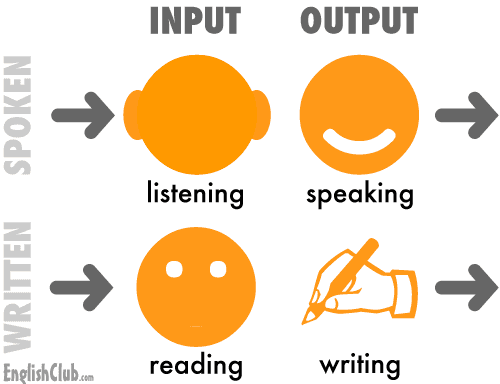

The 4 language skills


The four language skills are related to each other in two ways:
  • the direction of communication (in or out)
  • the method of communication (spoken or written)

READING

READING 


Reading is a receptive skill that involves responding to a text and making sense of a written text. It helps to understand the language of the text in different levels. Reading is an important part for language acquisition because it has a positive effect on student’s vocabulary knowledge.  it means that while students are reading they are picking up new vocabulary items.


WRITING

WRITING 


Writing skills are an important part of communication.  Good writing skills allow you to communicate your message with clarity and ease to a far larger audience than through face-to-face or telephone conversations.
You might be called upon to write a report, plan or strategy at work; write a grant application or press release within a volunteering role; or you may fancy communicating your ideas online via a blog.  And, of course, a well written CV or résumé with no spelling or grammatical mistakes is essential if you want a new job.
VIDEO: Here, you are going to find some strategies about how you can improve your writing.


LISTENING

LISTENING 


Listening is the capacity to understand and analyze what people are saying. It involves understanding the speaker's pronunciation, grammar, and vocabulary. 
Listening is the one skill that you use the most in everyday life. Listening comprehension is the basis for your speaking, writing and reading skills. To train your listening skills, it is important to listen actively, which means to actively pay attention to what you are listening to. Make it a habit to listen to audio books, podcasts, news, songs, etc. and to watch videos and films in the foreign language.
You should know that there are different types of listening:
  • Listening for gist: you listen in order to understand the main idea of the text.
  • Listening for specific information: you want to find out specific details, for example key words.
  • Listening for detailed understanding: you want to understand all the information the text provides.
Before you listen to a text, you should be aware of these different types. You will have to decide what your purpose is. Becoming aware of this fact will help you to both focus on the important points and reach your goal.

viernes, 19 de julio de 2019

READING

READING 

Reading is a receptive skill because learners do not need to produce language to do these, they receive and understand it. This skill is sometimes known as passive skill. It helps to understand the language of the text in different levels. 

Reading is an important part for language acquisition because it has a positive effect on student’s vocabulary knowledge.  It means that while students are reading they are picking up new vocabulary items. If you want to understand a text or sentence you need to understand the language of the text and you need to connect the text to the real world

Resultado de imagen para reading

VIDEO: Here you can find some strategies to learn how to read a text. 


WELCOMING

WELCOME TO LEARNING WITH JUAN

Resultado de imagen para learning english

In this site you are going to find a lot of information about how to learn english easily. Moreover, you are going to find some links where you coukd pratice different activites to develop the 4 main skills (READING, WRITING, SPEAKING, LISTENING). 

IF YOU WANT TO LEARN ENGLISH, THIS SITE WILL BE THE RIGHT PLACE TO DO IT.


REMEMBER:

PRACTICE MAKES PERFECT